
What is a MyoPro® Orthosis?

MyoPro logo.

The MyoPro® Orthosis for Weakened Upper Extremities

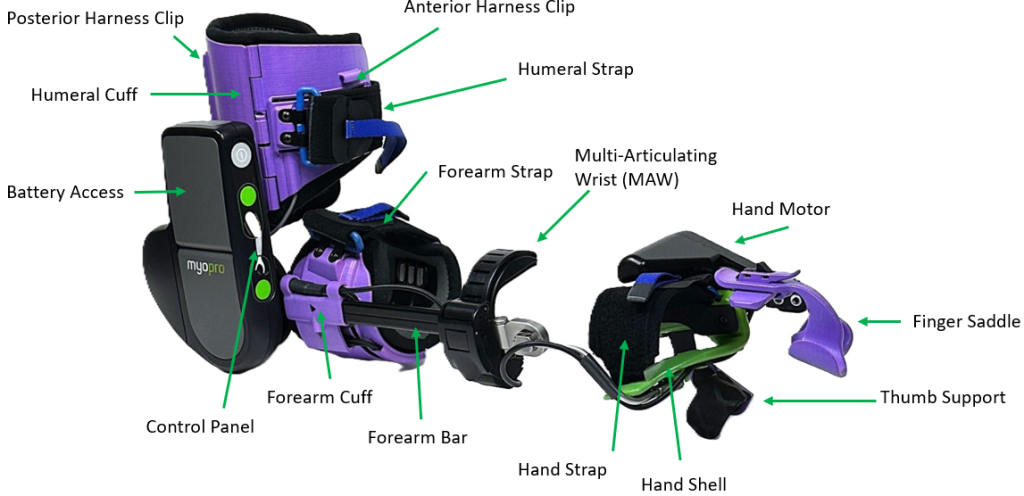
MyoPro® is a myoelectric powered arm and hand orthosis (brace) designed to help enable function to the wearer’s paralyzed or weakened upper extremities, helping individuals perform actions and daily activities that might otherwise be impossible.

The MyoPro may also facilitate rehabilitation including muscle re-education and increasing range of motion.

Wondering what a MyoPro costs and how it may be covered? Learn about MyoPro cost and coverage.

Many patients ask whether the MyoPro is covered by insurance. See MyoPro insurance coverage in 2026.

Find out if MyoPro® may be right for you, see if you qualify for a MyoPro.

How does the MyoPro® work?

Originally developed at MIT with Harvard Medical School, the MyoPro arm and hand orthosis device works by reading the faint nerve signals (myoelectric signals) from the surface of the skin (fully non-invasive, with no implants) then activating small motors to move the limb as the user intends (no electrical stimulation).

The user is completely controlling their own hand, wrist, elbow, and arm, while the myoelectric arm brace amplifies weak muscle signals to help move the upper limb. It has been called “power steering for your arm.”

The user is completely controlling their own hand, wrist, elbow, and arm, while the myoelectric arm brace amplifies weak muscle signals to help move the upper limb. It has been called “power steering for your arm.” Learn more about MyoPro 2X daily wear and what to expect as you build up wearing time.

While there are many brace products for those who have lost their arms, hands or legs, and while there are orthotic products to support weak legs, MyoPro is the only wearable myoelectric device on the market to help restore function for those who still have their arms and hands but are unable to use them.

Ready to take the next step? Learn how to get started with MyoPro.

A flow chart describing how the MyoPro works.
Screenshot 2025-05-14 102632

What conditions can be helped by the MyoPro Orthosis?

The most common medical conditions are those involving neuromuscular and neurological disease or injury, including:

History of Myoelectric Devices

The first myoelectric prosthesis was created between 1944-1948 by Reinhold Reiter, a physics student at Munich University. Reiter recog­nized that to work properly, the device needed to obtain maximum information from the myoelectric signal. Over the past 50 years, the technology has moved from single muscle control of a single prosthesis function to more complex muscle group activity control of multifunction prostheses. Central to these changes have been developments in extracting information from the myoelectric signal.

Later work expanded the concept of myoelectric control to orthoses for upper extremity impairment. By supporting research in 1990, the VA promoted and inspired the development for a future myoelectric orthosis that could benefit Veterans who have upper extremity impairment. In 2006, work in myoelectric upper extremity orthoses at MIT was commercialized resulting in the development of the Myo­Pro myoelectric elbow-wrist-hand orthosis (EWHO).

Image of an older model of the MyoPro, the MyoPro 1.

Myoelectric Arm Braces and Arm Orthoses: How the MyoPro Compares

A myoelectric arm brace is a powered orthosis that reads the electrical signals your own muscles produce and uses them to assist movement. Unlike a passive arm brace, which only supports or immobilizes the limb, a myoelectric device responds to the intent to move so the arm and hand are moved by the wearer rather than by a preset program.

Myoelectric orthosis vs. a passive arm brace

A passive arm brace holds the arm in position and is typically used for protection or to prevent contracture. A myoelectric orthosis such as the MyoPro actively assists elbow and hand movement, which allows the wearer to attempt functional tasks like reaching, grasping and releasing objects during daily activities.

Myoelectric orthosis vs. a prosthesis

A prosthesis replaces a limb that is missing. An orthosis supports a limb that is still present but weak or partially paralyzed. People searching for a myoelectric prosthesis who still have their arm are usually looking for a powered orthosis like the MyoPro rather than a prosthetic device.

Who a powered arm orthosis is for

Powered arm orthoses are used by people with arm weakness or partial paralysis following a stroke, brachial plexus injury, traumatic brain injury, spinal cord injury, or nerve damage. A clinical evaluation determines whether there is enough muscle signal present for the device to work.

Arm assist devices for daily activities

Arm assist devices are intended to restore function in everyday tasks such as eating, dressing, carrying objects, and two-handed activities. The goal is not only movement in therapy but usable arm and hand function at home and at work.

MyoPro FAQs

Frequently Asked Questions About the MyoPro

What is a MyoPro orthosis?

The MyoPro is a myoelectric arm orthosis a powered arm brace that senses the faint electrical signals from a wearer's own muscles and uses them to assist elbow and hand movement. It is custom fabricated for each user and is designed to support functional use of a weakened or paralyzed arm during daily activities.

How does the MyoPro work?

Sensors on the surface of the skin detect the electrical activity of the wearer's muscles. When the wearer attempts to move, the device amplifies that signal and powers the elbow and hand components to complete the movement. Because the motion is initiated by the wearer, the arm is under their control rather than following a fixed pattern.

Does the MyoPro really work?

Outcomes vary by individual and may depend on factors including the amount of muscle signal present, correct fitting and programming, participation in therapy, and consistent practice with the device. Clinical evaluation determines whether a person is a candidate. Published research and user outcomes report improved ability to perform daily tasks such as eating, dressing and carrying objects when the MyoPro is fitted correctly and incorporated into an appropriate therapy and training program.

Is the MyoPro a prosthesis or an orthosis?

It is an orthosis. A prosthesis replaces a missing limb, while an orthosis supports and assists a limb that is still present but weak or paralyzed. People searching for a myoelectric prosthetic arm who still have their own arm are generally looking for a powered orthosis like the MyoPro.

What conditions can the MyoPro help with?

The MyoPro is used by people with arm weakness or paralysis resulting from stroke, brachial plexus injury, traumatic brain injury, spinal cord injury, and certain neuromuscular and nerve conditions. A clinician assesses each case individually.

Can the MyoPro help a partially paralyzed arm after a stroke?

In many cases, yes. The device is often used by stroke survivors with residual muscle activity in the affected arm. Even weak signals can be enough for the orthosis to assist movement, which is assessed during a clinical evaluation.

How is the MyoPro different from a standard arm brace?

A standard arm brace is static — it supports, positions or immobilizes the arm. The MyoPro is powered and responds to the wearer's own muscle signals, actively assisting elbow and hand movement so the wearer can attempt functional tasks.